Tank cleaning has always been a job where the risk profile and the operational pressure collide. You need the tank back in service, you need the asset prepared for inspection or maintenance, and you need the work completed without exposing people to unnecessary hazards.
That is why more operators are searching for a robotic tank cleaner.
A robotic tank cleaner is not a gimmick or a “nice to have” add-on. Done properly, it is a method for turning a historically high-risk, labour-heavy, confined space task into a controlled operation that can be planned, measured, and verified.
RJ Maclean Energy Services positions its patented robotic systems around exactly that shift, reframing tank cleaning as a non-entry process designed to reduce confined space exposure and improve predictability.
This guide explains what a robotic tank cleaner is, how it works in practice, where it fits best, what safety context matters, and how to evaluate a provider when you are planning a project.
What a robotic tank cleaner is and why the industry is moving towards non-entry cleaning
A robotic tank cleaner is a remotely operated cleaning system designed to clean tanks with minimal or no worker entry into the tank. The goal is straightforward: remove sludge, sediment, hydrocarbons, and residues while reducing exposure to the hazards that make tank cleaning one of the most safety-critical maintenance activities.
The core problem with traditional tank cleaning and why it is high-risk
Traditional tank cleaning often relies on opening, ventilating, testing, and then sending people into a confined space to wash down, break up deposits, and remove waste. Even where controls exist, the hazards are well known and serious.
OSHA has repeatedly highlighted tank cleaning as hazardous work, including fatal incidents where workers were overcome while cleaning inside tanks and tank cars, reinforcing the danger of enclosed spaces, vapours, oxygen deficiency, and the risks of rescue attempts. (OSHA)
These are not abstract risks. They are operational realities that drive EHS priorities, permit requirements, rescue planning, and downtime.
What non-entry means in practice and where it fits in the work scope
Non-entry does not mean “no planning” or “no controls.” It means the cleaning work is designed so that the cleaning and removal steps are completed without sending people into the tank for the primary cleaning activities.
RJ Maclean describes its approach as redefining tank cleaning by removing one of the most hazardous practices in the process: confined space entry, using patented robotic systems to transform cleaning into a controlled and measurable process.
In practice, non-entry methods may still involve external preparation, isolation, verification, and site safety management. However, the most exposure-heavy portion of the work is shifted from human entry to remote operation.
When robotic tank cleaning is the right tool and when it may not be
Robotics are strongest when the risks and constraints of manual entry are high, and the residue profile is suitable for remote removal methods.
Robotic tank cleaning is often a strong fit when:
- Residues are hazardous or volatile.
- Confined space entry is difficult to justify from an EHS perspective.
- Downtime pressure is high, and predictability matters.
- Multiple tanks are being cleaned as part of a programme.
- You need verifiable preparation for inspection or maintenance.
There are also cases where robotics may not be the only tool required, such as extremely hardened deposits in complex geometries, or where site constraints limit access or recovery. A competent provider should explain those limits clearly and propose a realistic method, rather than overselling.
How a robotic tank cleaning system works in plain terms
Buyers often get pitched “robotic” as if it is one device that does everything. In reality, a robotic tank cleaner is a system. It is the combination of tooling, remote control, residue mobilisation, recovery, and verification, integrated into a work plan that matches the tank and product.
Key components: robotic tooling, control, recovery and waste handling interface
At a high level, a robotic cleaning setup usually includes:
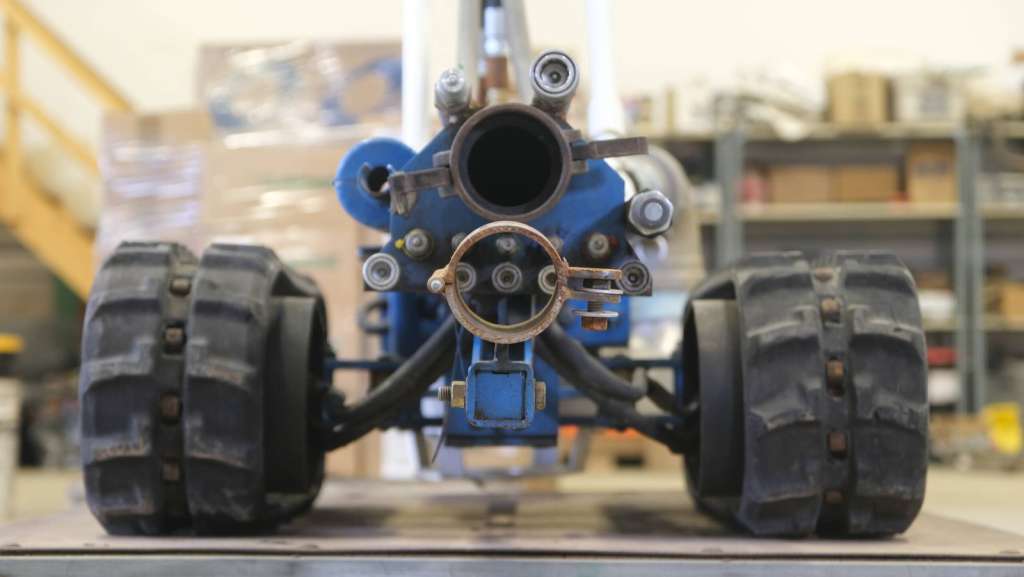
A robotic unit or tooling designed to operate within the tank environment.
A remote control system that allows the operator to work from a safe position.
A method to mobilise residues so they can be recovered, which can include mechanical agitation, fluid jets, or other techniques, depending on the residue.
A recovery interface that moves the mobilised waste out of the tank and into your waste handling chain.
RJ Maclean positions its systems as engineered for industrial cleaning, with robotic and automated tank cleaning services designed to deliver measurable results.
How sludge and residues are broken up, mobilised, and removed
For most operations, the work is about controlled mobilisation. Sludge and sediment are not “cleaned away” like a kitchen surface. They are broken up and moved into a recoverable form.
Non-entry cleaning descriptions commonly reference breaking up sludge and residues and removing them without entry, which aligns with the way RJ Maclean frames its robotic cleaning systems for removing sludge, hydrocarbons, and sediment.
The practical point for buyers is this. You want a method that can:
Mobilise the residue you actually have, not the residue the sales deck assumes.
Recover it efficiently.
Interface cleanly with your waste handling approach.
Keep the process controlled and safe.
Verification and measurable outcomes: what buyers should expect
Robotic tank cleaning should produce evidence that the work has been completed to the required standard. That might be preparation for internal inspection, maintenance, lining work, or return to service.
RJ Maclean repeatedly uses language like controlled, measurable, and verifiable, and references consistent results that prepare tanks for regulatory inspection contexts.
For procurement and operations teams, this matters because it supports:
- Clear scope acceptance.
- Reduced rework.
- Better shutdown planning.
- Audit-friendly documentation
Safety and compliance context for tank cleaning
A robotic tank cleaner is not a substitute for a safety programme. It is a risk reduction strategy that changes how risk is distributed across the job.
Confined space entry hazards and why employers must control them
Confined space hazards during tank cleaning can include toxic atmospheres, flammable vapours, oxygen deficiency, engulfment risks, and heat stress. In addition, rescue operations are dangerous because rescuers can be overcome if they enter without adequate controls.
OSHA’s enclosed tank cleaning publication describes fatal incidents during tank cleaning work, highlighting the severity of the hazards and the need for robust control measures. (OSHA)
How non-entry methods can reduce exposure, not replace safety management
Non-entry methods aim to reduce how often and how long people are exposed to the inside of the tank. That can reduce the number of permits, entries, and rescue readiness events required for the primary cleaning phase.
However, safe tank cleaning still requires planning, isolation, atmospheric awareness, ignition control, and site safety integration. Any competent provider should position robotics as a way to reduce exposure, not as a shortcut around safety.
How standards such as API 2015 relate to planning and risk control
API Standard 2015 is widely referenced in the petroleum storage context as a framework for planning, coordinating, and conducting tank entry and cleaning operations. An API publication overview describes it as covering safe planning and coordination from removal from service through service return. (API)
Even when non-entry methods are used, the mindset of structured planning, hazard assessment, and coordinated execution remains relevant. Non-entry changes the method. It does not eliminate the need for disciplined controls.
Operational benefits buyers care about
Robotics become attractive because they align with the pressures that keep tank cleaning difficult: downtime, safety risk, and uncertainty.
Reduced downtime and faster return to service, where the time savings come from
Time savings are rarely magic. They come from reducing bottlenecks.
Non-entry methods can reduce time lost to repeated entry cycles, manual labour constraints, and stop-start workflows caused by atmospheric issues or access limitations. RJ Maclean positions robotic tank cleaning as designed for safer, faster, and more efficient industrial cleaning.
If you are planning a shutdown or a multi-tank programme, even small improvements in predictability can be as valuable as raw speed, because predictability protects the rest of the schedule.
Predictability and control in shutdown planning and execution
Traditional tank cleaning can be unpredictable because conditions inside the tank change as residues are disturbed and vapours shift. Manual processes also vary by crew and by access.
RJ Maclean positions its approach around predictable delivery and measurable outcomes, a message that directly targets planning pain.
Data, reporting, and audit readiness for safety and ESG narratives
More operators now need documentation that supports safety reporting, contractor management, and broader sustainability narratives.
RJ Maclean frames its systems as delivering consistent, verifiable results and positions non-man entry cleaning as reducing worker risk while supporting tanks being prepared for inspection contexts.
Whether you call it ESG, safety metrics, or compliance reporting, the commercial reality is the same. If you can demonstrate risk reduction and controlled execution, you strengthen your internal business case and your external reporting.
Common use cases for robotic tank cleaners
A robotic tank cleaner is not limited to one niche. It becomes most valuable where residues are heavy, conditions are hazardous, and uptime matters.
Crude, bitumen, and heavy residue tanks
Heavy residue tanks create the classic pain points: sludge buildup, sediment layers, and complex clean-out requirements.
RJ Maclean’s paid landing content explicitly references the removal of sludge, hydrocarbons, and sediment without confined space entry, aligning with this use case.
Petrochemical and VOC-sensitive storage where control matters
Petrochemical storage and VOC-sensitive facilities often demand tighter controls, particularly around vapours and ignition risks. Robotics can be attractive here because remote operation can reduce exposure time and support controlled workflows.
RJ Maclean also highlights its ability to support predictable and controlled industrial cleaning, which is relevant for these environments.
Terminals, midstream storage, and multi-tank programmes
Terminal and midstream operators often plan cleaning as a programme rather than a one-off job. The buyer’s pain is not only about cleaning performance. It is scheduling, predictable turnaround, and minimising operational disruption.
RJ Maclean’s tank cleaning services content and its services overview pages position the company around multi-site capability, hubs in Alberta and Texas, and a track record across North America.
Pressure vessels and complex assets, where robotics can improve access
Robotics are often useful where geometry or access makes manual work difficult.
RJ Maclean positions its broader capability around industrial tank cleaning and related specialised cleaning services, which can include vessels and complex assets depending on the scope.
For buyers, the key question is not whether the provider says they can do it. It is whether they can explain the method, the constraints, and what verification looks like.
What to look for when evaluating a robotic tank cleaning provider
A robotic tank cleaner is a capital-intensive, safety-sensitive service. Choosing a provider is not about the cheapest day rate. It is about risk, outcome, and integration.
Safety documentation, procedures, and site integration expectations
Start with safety.
Ask how the provider manages job hazard analysis, isolation planning, and integration with your site permit systems. Ask how they handle atmospheric risks and how they plan for incidents, even if entry is reduced.
OSHA resources on tank cleaning hazards reinforce why employers must treat tank cleaning as high risk work requiring disciplined controls. (OSHA)
A credible provider will be comfortable discussing these topics in detail.
Waste handling, disposal interfaces, and environmental controls
Tank cleaning creates waste. The question is how smoothly the provider can interface with your waste handling chain.
Ask what forms of waste are expected, how recovery is managed, and what the handoff looks like. Ask how they control spills and how they support environmental requirements on site.
A provider that talks only about the robot, and not about recovery and waste handling, is leaving out half the job.
Turnaround commitments, scope clarity, and verification deliverables
- A buyer needs scope clarity.
- What is included?
- What is excluded?
- What “clean” means for your purpose.
- How the outcome is verified.
RJ Maclean repeatedly uses measurable and verifiable language. The commercial test is whether those words translate into deliverables that you can put in a scope document and sign off on at the end.
Mobilisation capability and regional support
Robotics are not helpful if the provider cannot mobilise reliably or support multiple sites.
RJ Maclean states it has operational hubs in Alberta and Texas and a track record across North America, which supports the expectation of regional mobilisation.
If your project is time sensitive, mobilisation capability is not a detail. It is a decision criterion.
Why RJ Maclean
If you are evaluating a robotic tank cleaner vendor, the question is not only “do you have a robot?” It is “can you deliver a controlled outcome, repeatedly, under industrial constraints.”
Patented robotic systems and engineered processes
RJ Maclean positions its tank cleaning approach around patented robotic systems designed to convert tank cleaning into a controlled and measurable process, with a focus on reducing confined space entry.
That positioning matters because it signals an engineered process, not improvised equipment.
Operational footprint and deployment capability
RJ Maclean’s services content highlights operational hubs in Alberta and Texas and a track record across North America.
For procurement and operations teams, that speaks to mobilisation and support.
What a scoping call looks like and what information they need from you
A good scoping call is practical. You should expect questions like:
- What is the tank type and size?
- What product was stored?
- What residue profile do you expect?
- What is the access situation?
- What is the target outcome: inspection preparation, maintenance, or return to service?
- What is the schedule and site constraint picture?
- When you prepare that information upfront, you reduce back and forth, and you increase the chance of receiving a scope that matches reality.
RJ Maclean’s contact and service pages are designed to move buyers towards that kind of project scoping conversation.
FAQ
What is a robotic tank cleaner, and how is it different from manual tank cleaning
A robotic tank cleaner is a remotely operated system designed to mobilise and remove residues from tanks with reduced or eliminated human entry into the tank. Manual tank cleaning often relies on workers entering the tank for wash down and residue removal, which increases exposure to confined space hazards.
Does robotic tank cleaning eliminate confined space entry completely
Not always. Many non-entry programmes are designed to reduce entry for the primary cleaning work, but some projects may still require limited entry for specific tasks, verification, or maintenance activities, depending on site and tank requirements. Robotics should be viewed as a risk reduction approach, not a blanket guarantee.
What tank types are suitable for non-entry robotic cleaning
Robotic tank cleaning is commonly used for storage tanks with sludge, sediment, and hydrocarbon residues, and it can be applied across a range of industrial environments. Suitability depends on residue type, access, geometry, and the outcome required.
How long does robotic tank cleaning take compared to traditional methods
Project duration depends on tank size, residue volume, access constraints, and verification requirements. Non-entry methods can reduce downtime by improving control and reducing labour-intensive entry cycles, but the right comparison is project-specific and should be scoped based on your tank and residue profile.
What information do you need to quote a robotic tank cleaning project
At minimum: tank dimensions, previous contents, expected residues, access constraints, schedule requirements, and the purpose of cleaning. Providing this information upfront helps the provider propose the correct method and define measurable deliverables.
Can robotic tank cleaning support compliance and reporting requirements
Many operators require documentation for safety, inspection readiness, and internal reporting. Providers that deliver controlled and verifiable outcomes can support those needs through a clear scope, verification steps, and reporting aligned to your site requirements.
Make tank cleaning safer and more predictable
A robotic tank cleaner is not just a piece of equipment. It is a method for changing the risk and predictability profile of tank cleaning work.
When non-entry robotic cleaning is appropriate, it can reduce confined space exposure, improve control over the cleaning process, and support more predictable turnaround planning. That matters for safety teams, for operations teams, and for anyone who has had a shutdown programme derailed by uncertainty.
If you are planning a tank clean and you want a safer, more controlled approach, the next step is a scoping conversation. RJ Maclean’s patented robotic systems are positioned for industrial environments where safety, predictability, and measurable results are non-negotiable.